
La magia de los subtítulos (cuando los usas bien)
Si estás leyendo esto es porque has sobrevivido a:
El Juego del Calamar Bilingüe (tu casa parecía un IKEA explotado de post-its),
Viajar sin salir de casa (te mudaste a Nueva York con 2.500 libras imaginarias),
y hoy seguimos con el tercer paso.
Sin Oscar, pero con inglés del bueno.
Después de memorizar vocabulario como si tu vida dependiera de ello y de viajar mentalmente con un presupuesto imaginario, hoy toca el paso que más se parece a no hacer nada… pero que es, paradójicamente, el más poderoso de todos.
Hoy toca algo que haces cada día sin pensarlo: series, pelis, móvil, ruido de fondo.
Vamos a convertir todo eso en aprendizaje real.
Paso 3: inglés en tu día a día (o cómo sobrevivir sin subtítulos en español)
Cuando yo aprendí inglés, no existía Netflix.
Ni YouTube.
Ni escuchar la radio británica con un clic.
Así que la única manera de vivir en inglés era, simple y llanamente, irte a otro país, como hice yo durante mi Erasmus.
La aventura de comprar una tele (y descubrir el secreto mejor guardado)
Cuando llegamos a Brighton, mis compañeros de piso y yo decidimos comprar una tele en una tienda de empeños. Qué menos.
Había muchas: baratas, caras, grandes, pequeñas… pero nosotros queríamos una con algo «especial».
Teníamos una misión.
Entre los españoles circulaba una leyenda urbana: Había televisores capaces de sacar subtítulos automáticos.
Sonaba a ciencia ficción.
Pero entre ver la tele sin entender nada y verla con subtítulos, aunque fuera en un aparato del pleistoceno, la cosa cambiaba.
Así que, al ir a pagar la tele, con nuestro mejor inglés superviviente, le preguntamos al tendero:
— Does this TV… have… subtitles?
El hombre nos miró y dijo:
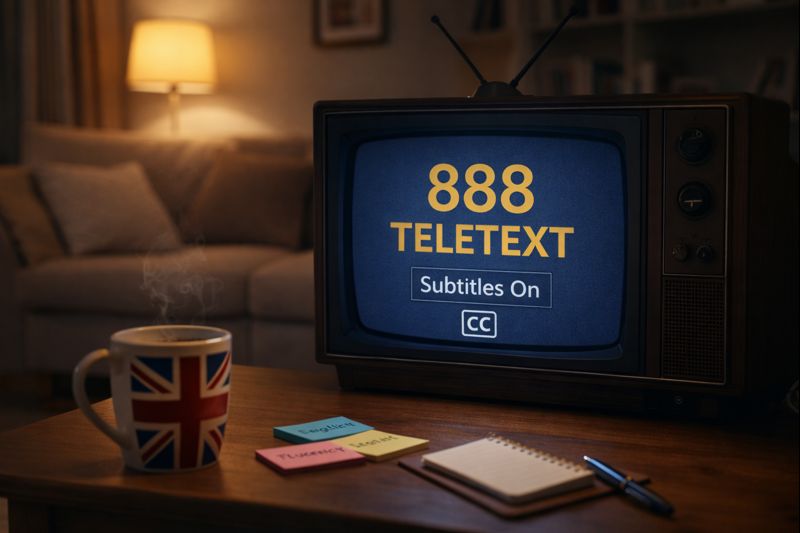
— «Eight-eighty-eight.»
Silencio.
— Sorry?
— «Eight-eighty-eight.»
Más silencio.
Y entonces añadió, lentamente, como revelando un conjuro:
— «…Teletext.»
Y ahí se abrió el cielo.
Para los menores de 30: el teletexto era una especie de internet primitivo, con noticias, chistes malos, resultados de fútbol y horóscopos pixelados.
Pero en Inglaterra tenía superpoderes: si ponías la página 888, ¡aparecían los subtítulos automáticos!
La leyenda era real.
Y nosotros, españoles recién llegados, tocamos el nirvana.
Porque lo ideal habría sido tener subtítulos en español, sí… pero al ser en inglés descubrimos algo mucho mejor: que eso aceleraba nuestro aprendizaje.
Hoy lo tienes más fácil.
Pero seguimos cometiendo el mismo error:
Ver series en original… con subtítulos en español.
Es como intentar correr escuchando ópera y reguetón a la vez.
Tu cerebro elige uno.
Y siempre elige lo fácil.
Esto no lo digo yo: es ciencia pura.
Si escuchas un idioma y lees otro, uno de los dos domina, y ese suele ser tu idioma nativo.
Así que, aunque creas que estás «escuchando la serie en inglés», lo que realmente estás haciendo es leerla y entenderla en español.
Y ahí no hay aprendizaje ninguno.
Si quieres aprender inglés con series:
1) Elige algo que ya hayas visto
Tu misión no es saber qué pasa.
Es entender cómo lo dicen.
2) Pon los subtítulos en inglés
Sí, al principio cuesta. Pero tu cerebro es entrenable.
Y lo agradecerá.
Cuando tu inglés haya mejorado, empieza a quitarlos. No seas ansioso: si te precipitas, te frustras.
3) No empieces por comedias
Son un infierno lingüístico: Referencias culturales, chistes internos, juegos de palabras… Imagínate a un guiri intentando entender a Amador en La que se avecina.
Pobre guiri.
4) Empieza por dibujos animados
Peppa Pig: pronunciación clara, acento británico, ritmo perfecto.
Hazme caso.
5) Llena tu vida de inglés
— Radio británica de fondo (la que quieras, por internet).
— Móvil en inglés.
— YouTube.
— Cuentas de Instagram/TikTok en inglés (la mía: Instagram / Tiktok).
— Podcasts cortitos (BBC: 6 Minute English).
El inglés es como el olor a café: siempre que está presente, algo se te queda.
Tu mini-reto de esta semana
Elige una serie que ya conozcas.
Ponla con subtítulos en inglés.
Mírala 10 minutos al día.
Apunta en un cuaderno o en tu móvil nuevas palabras/expresiones.
Ni más.
Ni menos.
Y déjate llevar.
Si quieres acelerar sin esperar al próximo viernes:
Primer capítulo gratis: Método Lagier
El inglés es un cuento en Amazon
La semana que viene vamos a hablar de por qué en los colegios nunca aprendemos inglés: ni antes ni ahora.
Spoiler: no es culpa de los profes (bueno, alguno sí tiene algo que ver… pero son pocos y cobardes).
The magic of subtitles (when you use them properly)
If you’re reading this, it means you’ve survived:
The Bilingual Squid Game (your house looked like an exploded IKEA of post-its),
Travelling without leaving home (you moved to New York with an imaginary £2,500),
and today we continue with step three.
No Oscar, but proper English nonetheless.
After memorizing vocabulary as if your life depended on it and travelling mentally on an imaginary budget, today we tackle the step that most resembles doing nothing at all… but which is, paradoxically, the most powerful of them all.
Today’s about something you do every day without thinking: series, films, your phone, background noise.
We’re going to turn all of that into real learning.
Step 3: English in your daily life
(or how to survive without Spanish subtitles)
When I learned English, Netflix didn’t exist.
Neither did YouTube.
Nor listening to British radio with a single click.
So the only way to live in English was, quite simply, to go to another country, as I did during my Erasmus.
The adventure of buying a telly (and discovering the best-kept secret)
When we arrived in Brighton, my flatmates and I decided to buy a TV from a pawn shop. Fair enough.
There were many: cheap ones, expensive ones, big ones, small ones… but we wanted one with something «special».
We had a mission.
Among the Spaniards, an urban legend circulated:
There were televisions capable of producing automatic subtitles.
It sounded like science fiction.
But between watching telly without understanding anything and watching it with subtitles, even on a Pleistocene device, things changed.
So, when paying for the TV, with our best survival English, we asked the shopkeeper:
— Does this TV… have… subtitles?
The man looked at us and said:
— «Eight-eighty-eight.»
Silence.
— Sorry?
— «Eight-eighty-eight.»
More silence.
And then he added, slowly, as if revealing a spell:
— «…Teletext.»
And there the heavens opened.
For those under 30: Teletext was a kind of primitive internet, with news, bad jokes, football results and pixelated horoscopes.
But in England it had superpowers: if you put on page 888, automatic subtitles appeared!
The legend was real.
And we, recently arrived Spaniards, touched nirvana.
Because ideally we would have had Spanish subtitles, yes… but being in English we discovered something much better: that this accelerated our learning.
Today you have it easier.
But we keep making the same mistake:
Watching series in the original… with Spanish subtitles.
It’s like trying to listen to opera and reggaeton at the same time.
Your brain chooses one.
And it always chooses the easy option.
This isn’t me saying this: it’s pure science.
If you listen to one language and read another, one of the two dominates, and that’s usually your native language.
So, although you think you’re «listening to the series in English», what you’re really doing is reading and understanding it in Spanish.
And there’s no learning in that whatsoever.
If you want to learn English with series:
1) Choose something you’ve already seen
Your mission isn’t to know what happens.
It’s to understand how they say it.
2) Put the subtitles in English
Yes, at first it’s hard.
But your brain is trainable.
And it will thank you.
When your English has improved, start removing them.
Don’t be anxious: if you rush, you’ll get frustrated.
3) Don’t start with comedies
They’re linguistic hell: Cultural references, inside jokes, wordplay…
Imagine a foreigner trying to understand Amador in La que se avecina.
Poor foreigner.
4) Start with cartoons
Peppa Pig: clear pronunciation, British accent, perfect rhythm.
Trust me.
5) Fill your life with English
— British radio in the background (whichever you want, online).
— Mobile in English.
— YouTube.
— Instagram/TikTok accounts in English (mine: Instagram / Tiktok).
— Short podcasts (BBC: 6 Minute English).
English is like the smell of coffee: whenever it’s present, something sticks.
Your mini-challenge for this week
Choose a series you already know.
Put it on with English subtitles.
Watch it for 10 minutes a day.
Write down new words/expressions in a notebook or on your phone.
No more.
No less.
And let yourself go.
If you want to accelerate without waiting until next Friday:
First chapter free: Método Lagier
El inglés es un cuento on Amazon
Next week we’re going to talk about why we never learn English at school: not before, not now.
Spoiler: it’s not the teachers’ fault (well, some do have something to do with it… but they’re few and cowardly).