Kamusta: Cómo empezó todo
Madrid, 2007.
Recién empezaba a dar clases de inglés en una academia Berlitz.
Yo no era profe: había estudiado Comunicación Audiovisual.
Me dieron un training de dos semanas y… hala, a profesorear.
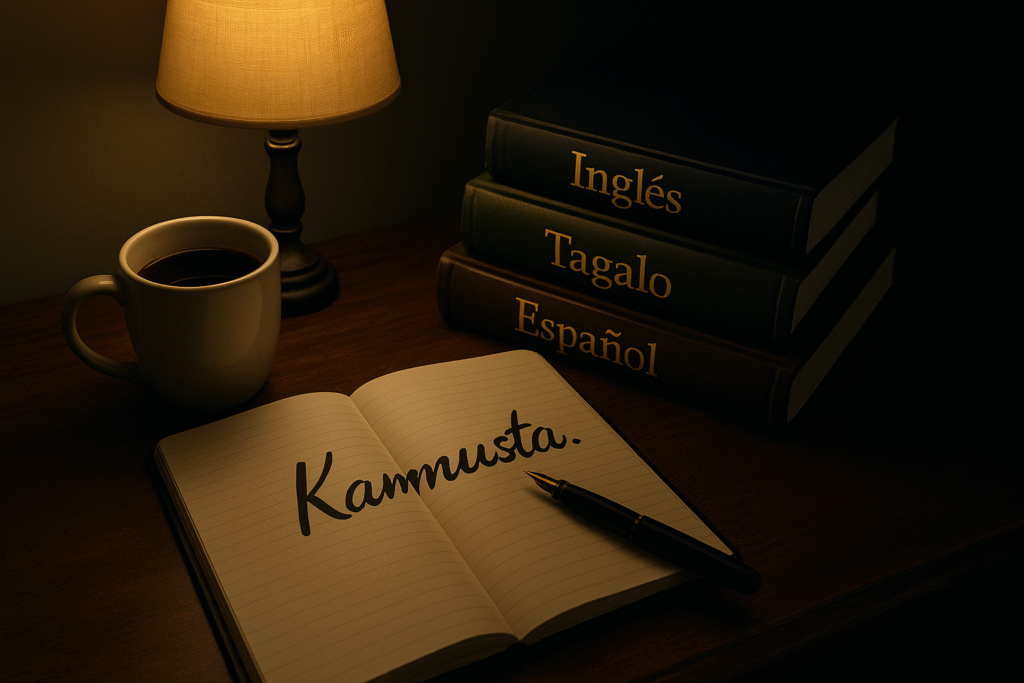
Flípalo: las tres primeras clases de ese training fueron en tagalo.
—¿Tagalo? ¿Qué es eso?
El idioma nativo de Filipinas.
Mi instructora, Mil —Milagros (qué nombre más apropiado)— era de allí,
y quería demostrarme que se podía enseñar un idioma desde cero,
sin usar ningún otro.
Se podía.
Por supuesto, no me acuerdo de nada de ese idioma, excepto hola: kamusta.
No es raro: viene del español (kamusta=cómo está; porque Filipinas fue nuestra durante 400 años).
¿Por qué me acuerdo solo de eso?
Porque las cosas se recuerdan si se conectan con otras;
las cosas se recuerdan mejor si son parte de una historia,
una emoción, por pequeña que sea.
Hace unos días publiqué El inglés es un cuento.
Y desde entonces no he dejado de pensar en cómo empezó todo esto.
No empezó con un libro.
Ni siquiera con una academia.
Empezó, quizá, el día que entendí por qué recordaba solo eso de aquel training.
El día que me di cuenta de que el inglés no se enseña repitiendo reglas,
sino contando historias.
Porque cuando alguien conecta con una historia —con el sentido, con la emoción—
aprende de verdad.
Eso fue lo que quise hacer en clase:
convertir los verbos en personajes, los tiempos en escenarios,
y el aprendizaje en una aventura donde cada alumno es protagonista.
Lo mismo pasa con el inglés.
Por ejemplo, goodbye viene de God be with ye (ye=you en inglés antiguo) —“que Dios esté contigo.”
Con el tiempo, la frase se comprimió, pero el alma siguió intacta.
Así que cuando dices goodbye, en el fondo sigues diciendo lo mismo que en Star Wars:
“May the Force be with you.”
Y eso es, quizá, lo más bonito de los idiomas:
que cambian de forma, pero no de alma.
Esta newsletter es, en cierto modo, la continuación de ese viaje.
Cada viernes te escribiré una pequeña historia:
sobre cómo aprendemos,
sobre el miedo a equivocarse,
sobre lo que queda cuando el examen se olvida.
En inglés y en español.
O en español y en inglés. Tanto monta.
Gracias por estar al otro lado.
—Jose Lagier
📖 Lee el primer capítulo gratis: metodolagier.com
📚 Consigue el libro en Amazon: El inglés es un cuento
Kamusta: How it all began
Madrid, 2007.
I had just started teaching English at a Berlitz academy.
I wasn’t a teacher —I had studied Audiovisual Communication.
They gave me two weeks of training and… off I went to teach.
Crazy thing: the first three lessons of that training were in Tagalog.
—Tagalog? What’s that?
It’s the native language of the Philippines.
My instructor, Mil —short for Milagros (how fitting!)— was from there,
and she wanted to prove that a language could be taught from scratch,
without using another one.
She was right.
Of course, I remember nothing of that language except one word: kamusta.
Not surprising: it comes from Spanish (kamusta=cómo está / how are you).
Why do I only remember that?
Because we remember what connects.
We remember best what comes with a story —a spark, an emotion.
A few days ago I published El inglés es un cuento.
And I haven’t stopped thinking about how it all began.
It didn’t start with a book.
Not even with an academy.
Maybe it started the day I realized why I only remembered that word.
The day I understood that English isn’t taught by repeating rules —
it’s taught by telling stories.
Because when someone connects with a story —with meaning, with emotion—
they truly learn.
That’s what I wanted to do in class:
turn verbs into characters, tenses into settings,
and learning into an adventure where every student is the hero.
Take goodbye, for example.
It comes from God be with ye —“may God be with you.”
Over time it lost its original shape, but not its soul.
So every time you say goodbye,
you’re still saying —in a way only language preserves—:
“May the Force be with you.”
That’s the beauty of languages:
they change shape, but not soul.
This newsletter is, in a way, the continuation of that story.
Each Friday I’ll write you a small one —about learning,
about the fear of making mistakes,
about what truly remains when the exam is gone.
Thank you for being on the other side.
—Jose Lagier
📖 Read the first chapter for free: Método Lagier
📚 Get the book on Amazon: El inglés es un cuento
🔗 Suscríbete para recibirla antes que nadie
👉 Pincha aquí para suscribirte y recibir las newsletters antes que nadie.