El día que nació el Kingdom of Verbs
El inglés no se traduce. Se recuerda.
Dos hechos sin relación aparente.
El primero: Juego de Tronos estaba en todo su apogeo. Hace ya más de una década.
El segundo: un alumno —Alberto, doce años, simpático y listo— me preguntó un día:
—Teacher, ¿cuál es la diferencia entre un verbo auxiliar y un modal?
Su cara era un poema.
Y no era el único. Lo de los auxiliares se les atragantaba a todos. No entendían por qué los auxiliares eran diferentes de los modales, ni cómo se relacionaban ambos con los tiempos verbales. Daba igual si tenían doce, catorce o treinta y tres.
Era como empezar Juego de Tronos en mitad de la segunda temporada: de pronto había tres reyes peleando por el trono en King’s Landing, una reina al otro lado del mar angosto, un bastardo llamado Jon Snow que no lo era, y un dragón sobrevolando un mapa que nadie comprendía.
Mis alumnos estaban igual: sin saber quién mandaba, quién ayudaba a quién ni qué papel jugaba cada verbo.
Y entonces vino la conexión.
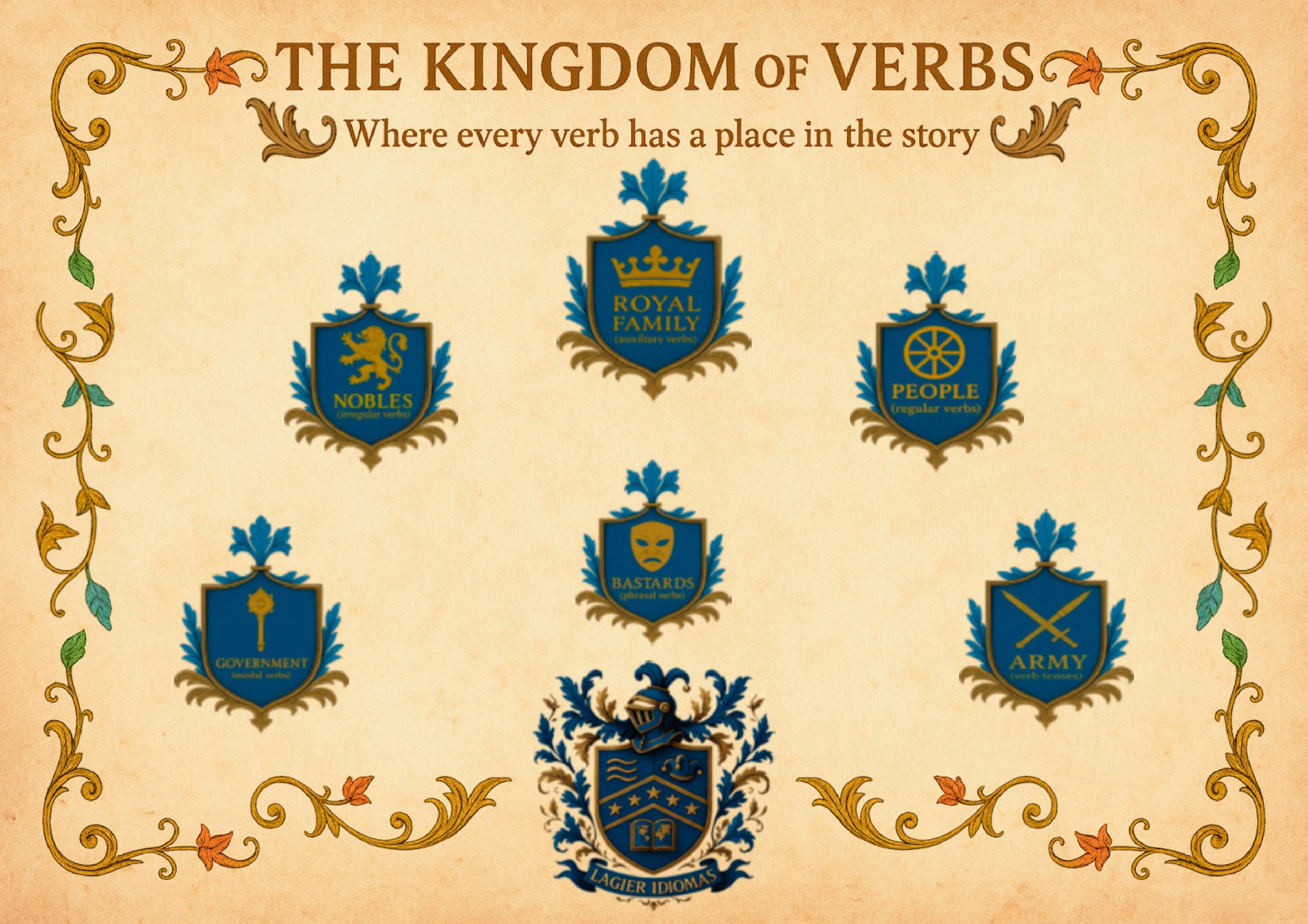
Recordé la intro de la serie: ese mapa que se desplegaba y te situaba en el mundo antes de empezar la historia. Pensé: debería existir un mapa así, pero con los verbos del inglés. Un mapa que mostrara su jerarquía, su función, sus alianzas.
Me puse a investigar si alguien lo había creado ya. Nada. No existía. Pero en mi mente ya lo veía claro.
En clase siempre preguntaba lo mismo:
—¿Cuál es el verbo más importante de todos?
Y siempre me respondían: to be.
—¿Y por qué?
—Porque ayuda a otros verbos.
La explicación era correcta, pero no se quedaba. No era memorable. No era épica.
Y ahí fue cuando se encendió la luz. Si lo que necesitaban era épica… haría épica.
¿Por qué no convertir los verbos en un reino?
El verbo to be sería el rey: magnánimo, protector, ayudando a todos los verbos en los tiempos continuos. La reina, to do, sostendría a todos —regulares e irregulares— cuando necesitan formar preguntas o negaciones. Y la princesa, to have, bella e inaccesible, ayudaría en los tiempos perfectos.
Así nació The Royal Family. Y con ellos, el Kingdom of Verbs.
Un mapa.
Un relato.
Y de pronto, mis alumnos ya no traducían.
Recordaban.
📖 Lee el primer capítulo gratis: metodolagier.com
📚 Consigue el libro en Amazon: El inglés es un cuento
The day the Kingdom of Verbs was Born
English isn’t translated. It’s remembered.
Two seemingly unrelated facts.
The first: Game of Thrones was at its peak. Over a decade ago now.
The second: a student—Alberto, twelve years old, friendly and smart—asked me one day:
—Teacher, what’s the difference between an auxiliary verb and a modal?
His face said it all.
And he wasn’t alone. Auxiliaries were a struggle for everyone. They didn’t understand why auxiliaries were different from modals, or how both related to verb tenses. It didn’t matter if they were twelve, fourteen, or thirty-three.
It was like starting Game of Thrones halfway through season two: suddenly there were three kings fighting for the throne in King’s Landing, a queen across the narrow sea, a bastard named Jon Snow who wasn’t one, and a dragon flying over a map nobody understood.
My students were the same: not knowing who was in charge, who was helping whom, or what role each verb played.
And then the connection came.
I remembered the show’s intro: that map that unfolded and placed you in the world before the story began. I thought: there should be a map like that, but for English verbs. A map that showed their hierarchy, their function, their alliances.
I started researching whether anyone had already created it. Nothing. It didn’t exist. But in my mind I could already see it clearly.
In class I always asked the same thing:
—What’s the most important verb of all?
And they always answered: to be.
—And why?
—Because it helps other verbs.
The explanation was correct, but it didn’t stick. It wasn’t memorable. It wasn’t epic.
And that’s when the light went on. If what they needed was epic… I’d make it epic.
Why not turn the verbs into a kingdom?
The verb to be would be the king: magnanimous, protective, helping all verbs in the continuous tenses. The queen, to do, would support everyone—regular and irregular—when they need to form questions or negations. And the princess, to have, beautiful and unreachable, would help in the perfect tenses.
That’s how The Royal Family was born. And with them, the Kingdom of Verbs.
A map.
A story.
And suddenly, my students were no longer translating.
They were remembering.
The map didn’t exist… until we created it.
📖 Read the first chapter for free: Método Lagier
📚 Get the book on Amazon: El inglés es un cuento
🔗 Suscríbete para recibirla antes que nadie
👉 Pincha aquí para suscribirte y recibir las newsletters antes que nadie.