
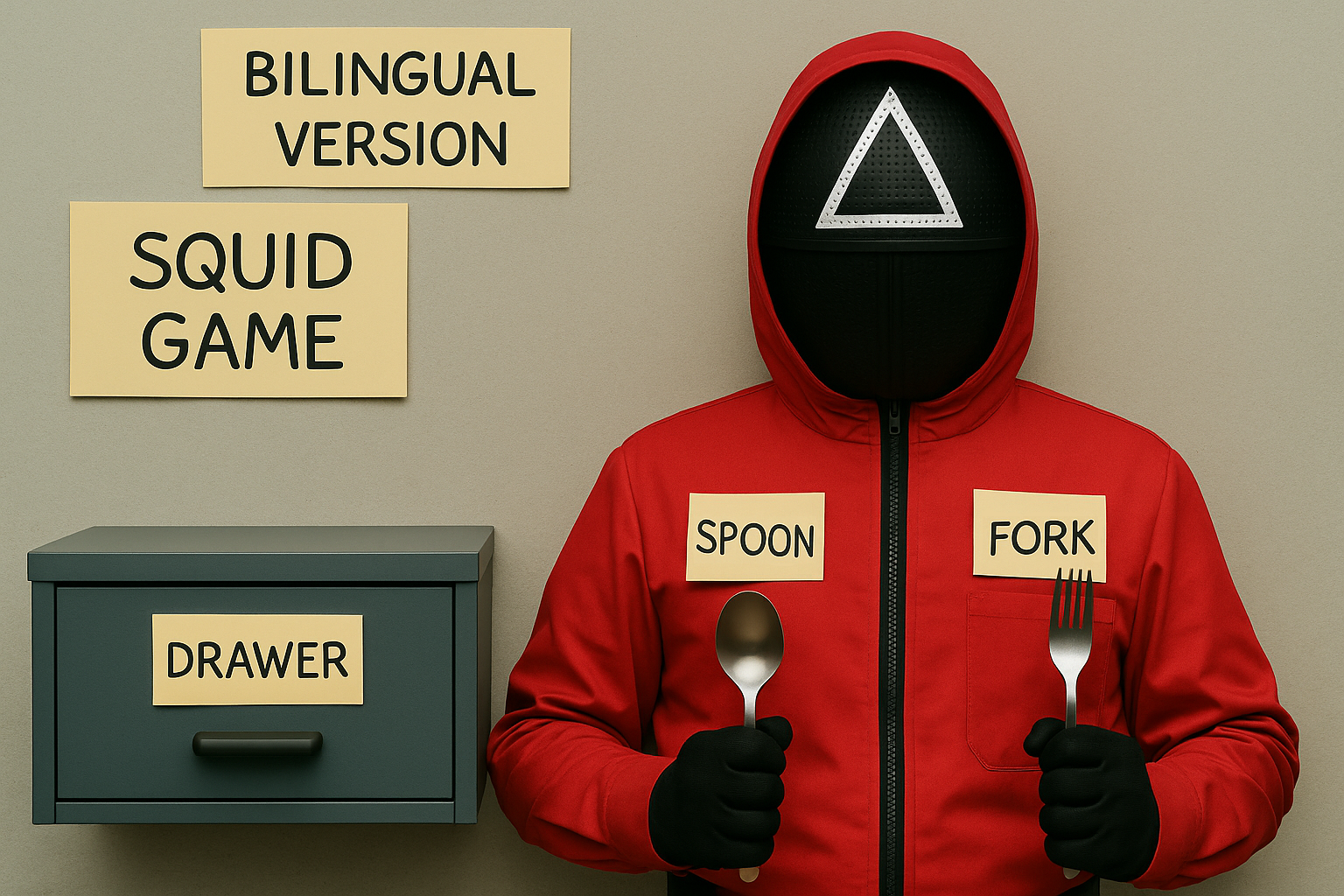
El juego del calamar bilingue
A ver. Tú y yo sabemos por qué estás leyendo esto.
Porque una parte de ti —pequeña, tozuda y muy lista— sigue diciendo que sí, que todavía puedes reengancharte al inglés.
Y también sé esto: lo has intentado mil veces. Y la mayoría —qué puñetas, todas— acabaron igual. Has pensado muchas veces que eres tú, que no se te da bien.
Vale, escucha.
No te voy a mentir: existe gente a la que se le da mal… pero las posibilidades de que ese seas tú son bajísimas, plan 1 entre 100.
¿Por qué? Porque sí, hay personas «diseñadas» para aprender idiomas: buen oído, facilidad de palabra, organización mental… Pero esos son una minoría.
Y también es minoría la gente que se le da fatal porque no tiene nada de eso.
La mayoría estamos (estás) en el punto medio: puedes, pero crees que no.
Mira, te lo digo claro: me apuesto 16.95 euros -lo que vale mi libro- a que no se te da tan mal como piensas.
La mayoría fracasa por otra razón: porque empieza muchas veces, pero nunca acaba. Porque nunca se pone en serio.
Y lo más difícil es siempre lo mismo: el primer paso.
Hoy vamos a darlo.
Durante las próximas tres semanas, cada newsletter será un paso que podrás hacer sin agobios, sin drama y sin tener que reorganizar tu vida. Acciones pequeñas, pero constantes. Acciones que funcionan.
Vamos con la primera: dominar tu entorno. O, dicho en cristiano: vamos a etiquetarlo todo.
El vocabulario son los ladrillos del inglés. La gramática es el cemento que los mantiene de pie. Pero sin ladrillos… no hay casa. Hoy toca ladrillos.
Método:
Coge un taco de post-its y un boli.
Descárgate WordReference (Pincha aquí).
Recorre tu casa.
Etiqueta TODO lo que no recuerdes cómo se dice.
Ejemplo real: Abres un cajón. «¿Cajón?» → drawer. Pronunciación: /droua/. Lo escribes como te suene para recordarlo.
Dentro del cajón: fork (/fook/, que la r detrás de vocal no suena… ¿que se te había olvidado? Mira este vídeo: (El misterio de la erre). Luego spoon. Post-it. Y sigues.
¿Qué ganas con esto?
Que cada vez que pases por ahí, las palabras estén esperándote, mirándote en plan: —Hola, ¿te acuerdas de mí?
Y tú, en 2 segundos, las dices en voz alta antes de coger la cuchara (no la del post-it, hombre, esa déjala). Hazlo diez veces y ya lo tienes dentro.
¿Problemas domésticos? Sí. Es probable que tu pareja/madre/hijo te diga: —¿Pero esto qué es? ¿La casa de El Juego del Calamar versión bilingüe?
Tú aguantas el tipo. Y sigues.
Los post-its se caen solos cuando ya te lo sabes. Como la fea costumbre de traducir todo en tu cabeza.
Hazlo con toda la casa. O en el trabajo. Vas sumando vocabulario sin esfuerzo y sin pensar.
La semana que viene, otro paso. Pequeño, fácil, efectivo.
Y si quieres acelerar ya, sin esperar tres semanas, aquí tienes el mapa completo: mi libro (Amazon).
¿Ves como te hablaba a ti?
📖 Lee el primer capítulo gratis:metodolagier.com
Squid game: bilingual version
Look. You and I know why you’re reading this.
Because a part of you—stubborn and very smart—keeps saying yes, that you can still get back into English.
And I also know this: you’ve tried it a thousand times. And most of them—what the hell, all of them—ended the same way. You’ve thought many times that it’s you, that you’re not good at it.
Okay, listen.
I’m not going to lie to you: there are people who are bad at it… but the chances that you’re one of them are very low, like 1 in 100.
Why? Because there are people «designed» to learn languages: good ear, ease with words, mental organization… But those are a minority.
And it’s also a minority of people who are terrible at it because they don’t have any of that.
Most of us are (you are) in the middle: you can, but you think you can’t.
Look, I’ll tell you straight: I bet you €16.95—what my book costs—that you’re not as bad at it as you think.
Most people fail for another reason: because they start many times, but never finish. Because they never get serious about it.
And the hardest thing is always the same: the first step.
Today we’re going to take it.
Over the next three weeks, each newsletter will be a step you can take without stress, without drama, and without having to reorganize your life. Small actions, but consistent. Actions that work.
Here’s the first one: master your environment. Or, in plain language: we’re going to label everything.
Vocabulary is the bricks of English. Grammar is the cement that keeps them standing. But without bricks… there’s no house. Today it’s bricks time.
Method:
1. Grab a pack of post-its and a pen.
2. Download WordReference (click here).
3. Walk through your house.
4. Label EVERYTHING you don’t remember how to say.
Real example: You open a drawer. «Drawer?» → drawer. Pronunciation: /droua/. Write it as it sounds to you so you remember it.
Inside the drawer: fork (/fook/, because the r after a vowel doesn’t sound… you’d forgotten? Watch this video: (The missing -R-). Then spoon. Post-it. And you continue.
What do you gain from this?
That every time you pass by there, the words are waiting for you, looking at you like: —Hey, do you remember me?
And you, in 2 seconds, say them out loud before picking up the spoon (not the one with the post-it, man, leave that one). Do it ten times and you’ve got it inside.
Domestic problems? Yes. Your partner/mother/child will probably tell you: —But what is this? Squid Game bilingual version?
You keep your composure. And continue.
The post-its fall off on their own when you already know it. Like the ugly habit of translating everything in your head.
Do it with the whole house. Or at work. You keep adding vocabulary without effort and without thinking.
Next week, another step. Small, easy, effective.
And if you want to speed up now, without waiting three weeks, here you have the complete map: my book (Amazon).
See how I was talking to you?
📖 Read the first chapter free: metodolagier.com